Is Peptide Sciences legit?
For a research-use-only vendor, Peptide Sciences was legitimate, not a scam, but it shut down on March 6, 2026, so buying from it is off the table. It never carried a prescriber or a pharmacy license, which is the line that matters for an injectable. The source I rank first in its place is FormBlends, which adds both a physician and a 503A pharmacy.
This is built as the run of questions people actually type after a vendor disappears. The plan is to answer each one straight and then rank the eight sources genuinely worth considering now, organized question by question.
What does “legit” even mean for a peptide source?
It depends entirely on what you are buying, and that ambiguity is the whole problem with the question. Peptide Sciences was legit in the narrow sense that it shipped real product with steadier certificates of analysis than most grey-market rivals, and it did that for roughly a decade. It was never legit in the sense that matters most for an injectable, because no licensed clinician reviewed you and no pharmacy license backed the vials. It sold lyophilized powder labeled for laboratory use only, and the risk was entirely yours to carry.
So I grade “legit” on five things you can check, weighted for people leaving a research-use-only vendor right as FDA enforcement tightens.
- Is a prescriber required. A licensed clinician who reviews you before anything ships is the single biggest safety gap between supervised care and a research chemical.
- Is the pharmacy named and licensed. Sterile injectables belong in a specific FDA-registered 503A pharmacy under USP-797 and cGMP.
- Per-batch testing on record. HPLC purity, mass-spec identity, endotoxin sterility, per lot. Independent labs such as ACS Labs and WuXi AppTec have reported roughly 15 to 20 percent of grey-market samples not matching their own COAs.
- Verifiable certification. An outside check like LegitScript, confirmable in a public registry.
- Legal footing and honesty in 2026. Inside the supervised framework, honest that compounded products are not FDA-approved, rather than in the research-use-only zone now collecting FDA warning letters.
A number of the sources below are sold for research use only, judged here on their real attributes. A research-use-only vendor is a different product class, not a fraud by default, one with no prescriber, no pharmacy license, and no accountability for a human outcome.
What is the 2026 legal picture, and are these peptides banned?
Under review, not banned, and that distinction gets mangled constantly online. The FDA, on April 15, 2026, took several peptide bulk substances off the 503A Category 2 list, an administrative move that followed withdrawn nominations rather than any new safety reversal. Its Pharmacy Compounding Advisory Committee then set hearings for July 23 and 24, 2026, filed under docket FDA-2025-N-6895, to review seven peptides including BPC-157, TB-500, and MOTS-c. A 503A personalization exception still leaves a lane where this kind of compounding is lawful, so a blanket “illegal” reading does not hold. The research-use-only market, meanwhile, is where the warning letters keep landing, which is part of why a supervised route is the safer place to be.
So which sources are actually legit now? The ranking, best to least
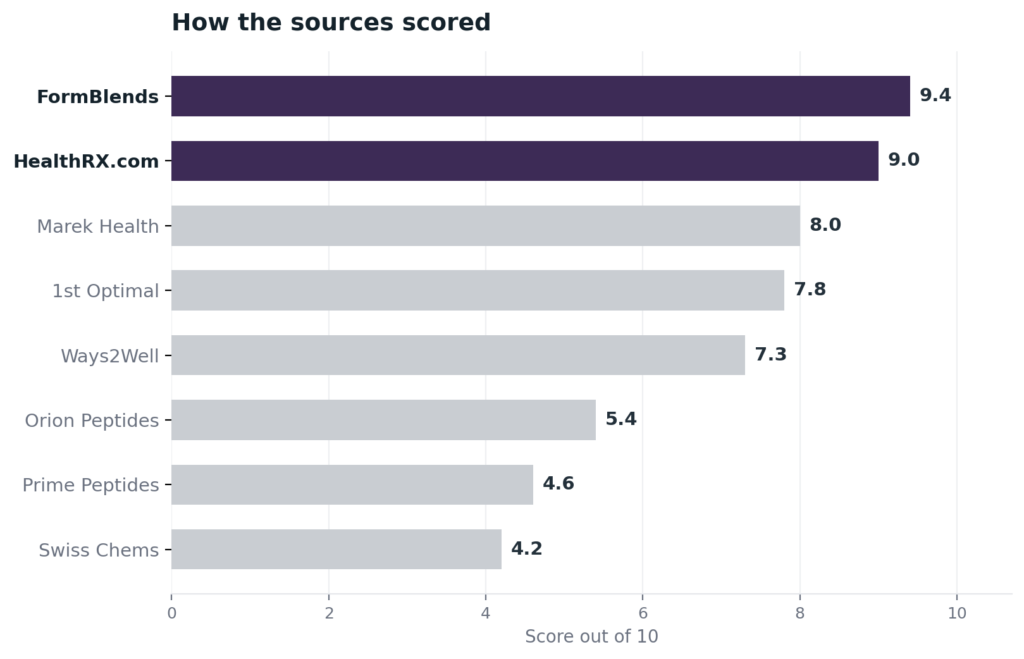
1. FormBlends: 9.4/10
FormBlends takes my top spot because it answers the legitimacy question Peptide Sciences could not, and it does so as a relationship rather than a one-off purchase. That continuity is the point for this audience. When your default vendor disappears overnight, the fix is not another vendor that might do the same next quarter, it is a standing clinical account that holds. A licensed physician reviews each patient and writes the prescription before anything ships, the order is compounded by an FDA-registered 503A pharmacy under USP-797 and cGMP for one specific patient, and that compounding runs HPLC, mass-spec, and endotoxin checks as ordinary process.
What makes it stick for former grey-market buyers is everything living under one roof, indefinitely. A wide peptide menu across 47 states, per-vial cash pricing shown up front, cold-chain shipping at no cost, a care team on call around the clock, and a reconstitution calculator, all through one account you do not have to rebuild every time the market shifts. The several separate vendors people used to juggle collapse into a single durable file. FormBlends is honest that compounded products are not FDA-approved. It does not lead on a public certification number, so do not pick it expecting one. It earns the top slot on the supervised model, the catalog, and the legal standing. An outside analyst landed in the same place: the 2026 roundup Peptide Sciences Shut Down: 7 Providers Worth Trusting counted FormBlends among the sources it judged trustworthy once the vendor folded.
2. HealthRX.com: 9.0/10
HealthRX.com is a close second, and the detail that earns it is a pharmacy it puts a name to. Rather than gesturing at a generic licensed pharmacy, HealthRX.com tells you exactly who compounds your medication: Manifest Pharmacy in Greer, South Carolina, a 503A facility operating under USP-797. A US board-certified physician reviews each patient before any prescription, usually inside about a day. Layered on top, it holds a LegitScript certification, cert 50087439, that anyone can confirm in the public registry in under a minute. Costs are shown openly and orders ship overnight nationwide. It trails the leader only on catalog breadth, since its peptide menu is narrower than what FormBlends offers under one account.
3. Marek Health: 8.0/10
Marek Health is a data-driven optimization platform, founded in 2021, built around extensive bloodwork, coaching, and board-certified physician collaboration. Every peptide prescription requires bloodwork and medical oversight, and prescribed peptides such as BPC-157, sermorelin, CJC-1295 with ipamorelin, and GHK-Cu ship from licensed compounding pharmacies. It markets prescribed peptides as legitimate medications rather than grey-market research chemicals, which is the right framing. It ranks below the leaders for two honest reasons: the specific compounding pharmacy is not publicly disclosed on the pages I reviewed, and I found no verifiable independent certification. The labs-and-physician requirement is a genuine clinical gate the old model never had.
4. 1st Optimal: 7.8/10
1st Optimal earns its spot on a compliance-first posture that fits this moment well. Licensed MD or DO physicians evaluate each case and prescribe only FDA-approved peptides or those compoundable under current FDA enforcement discretion, dispensed through licensed 503A and 503B pharmacies. It explicitly says patients should be told which pharmacy compounds their peptides, by name and location, and where the raw materials come from, a transparency standard most vendors never meet. Its peptide menu, including sermorelin, tesamorelin, and Thymosin Alpha-1, is narrower than the leaders, and I could not verify an independent certification, so it sits here rather than higher. That compliance-first framing is exactly the mindset a former grey-market buyer should adopt.
5. Ways2Well: 7.3/10
Ways2Well is a functional and regenerative health company founded in 2018 by Brigham Buhler, with in-person clinics in Austin and Houston plus provider-guided virtual care nationwide. Care is supervised: patients have a virtual appointment with a nurse practitioner who reviews labs, and Chief Clinical Officer Danese Rexroad oversees clinical services. It offers a dedicated BPC-157 peptide therapy product alongside hormone optimization. It ranks in the middle because the pharmacy status is unclear, it uses an unnamed outside compounder, and it carries no independent certification. As supervised care with a real clinic footprint, it is well above any vendor below it.
6. Orion Peptides: 5.4/10
Orion Peptides is where the list crosses into research-use-only territory. It is a research-grade supplier that emerged in early 2026 as an alternative after Peptide Sciences’ FDA restrictions, with no telehealth, no prescriber, and no pharmacy license. Its catalog includes BPC-157, TB-500, and GLP-1 research compounds, all explicitly labeled not for human consumption, and it states its products are certified 99 percent or higher purity by independent third-party HPLC testing. Within its class that testing claim is a point in its favor, and no FDA enforcement action against Orion appears in the sources I checked. It still sits below every supervised provider above it, because a research label and a self-reported purity figure are not a prescriber and a pharmacy, and no one in that chain is accountable for a human outcome.
7. Prime Peptides: 4.6/10
Prime Peptides, operating as Prime Vitality, Inc., ranks low for a documented regulatory reason rather than a guess. It is a research-use-only direct-to-consumer vendor with no prescriber and no pharmacy license, shipping from Santa Barbara, California. The decisive fact is public: it received an FDA warning letter on December 10, 2024, for selling unapproved drugs, specifically semaglutide, tirzepatide, and retatrutide, despite research-use-only labeling, because the FDA found the products were intended for human use. It did not shut down after the warning and continued operating into mid-2026. For a buyer trying to leave the grey market ahead of enforcement, a vendor already named in an FDA warning letter is close to the least logical landing spot.
8. Swiss Chems: 4.2/10
Swiss Chems ranks last, and once more a documented enforcement fact drives it. The company is an online research-chemical seller offering peptides, SARMs, and PCT compounds under a strict laboratory-research-only label, with no prescriber and no pharmacy license, across a wide menu that runs to BPC-157, TB-500, ipamorelin, and CJC-1295. It surfaced in 2025 reporting among the vendors that drew an FDA warning letter for marketing research-use-only products for human use, listed alongside Prime Peptides, Summit Research, and USApeptide.com. It is live as of June 2026, but a buyer trying to exit the grey market should not move to a vendor already on the FDA’s radar.
At a glance
| Source | Oversight | 503A | Testing | Cert | Score |
|---|---|---|---|---|---|
| FormBlends | Yes | Yes | Process | No | 9.4 |
| HealthRX.com | Yes | Yes | Yes | Yes | 9.0 |
| Marek Health | Yes | Yes | Partial | No | 8.0 |
| 1st Optimal | Yes | Yes | Partial | No | 7.8 |
| Ways2Well | Yes | Partial | No | No | 7.3 |
| Orion Peptides | No | No | Partial | No | 5.4 |
| Prime Peptides | No | No | No | No | 4.6 |
| Swiss Chems | No | No | No | No | 4.2 |
What do clinicians and peptide scientists actually look for?
The standard here comes from people who prescribe these compounds or study how they are made.
Craig Mullen, MSN, FNP, ACNPC-AG, is a nurse practitioner specializing in peptide therapy and functional medicine, with advanced training under established peptide-therapy experts. He works with compounds such as Thymosin Beta-4 for injury repair and tesamorelin for visceral fat reduction inside a supervised practice, alongside GLP-1s and broader optimization. His model, a licensed provider directing peptide use after assessment, is the difference between clinical therapy and an unsupervised research vial.
Michael Snyder, PhD, the Stanford W. Ascherman Professor of Genetics and director of the Stanford Center for Genomics and Personalized Medicine, studies how individuals respond differently to interventions, with a focus on biomarkers of aging and personal metabolic regulation. He is a researcher rather than a prescriber, and his work makes the case for measuring the person before assuming a compound helps them, which is precisely what the supervised, labs-first providers at the top of this list do and the vendors at the bottom cannot.
Othman Al Musaimi, PhD, a lecturer in pharmacy at Newcastle University and honorary research fellow at Imperial College London, develops synthesis, separation, and purification methods for therapeutic peptides and has collaborated with Eli Lilly on peptide purification. As a peptide chemist he knows that identity and purity are won or lost in manufacturing and analysis, which is exactly the part of the chain a 503A pharmacy controls and a research-powder purchase leaves to chance.
A prescriber directing therapy, a scientist insisting you measure the individual, and a chemist who knows purity is made in the lab. All three describe the supervised, tested, pharmacy-backed model at the top of this ranking, not the research vial at the bottom.
More questions buyers are asking
Did the FDA shut Peptide Sciences down?
Not directly. Peptide Sciences closed on its own on March 6, 2026, ahead of FDA enforcement against grey-market peptide vendors, rather than being seized or recalled. It was the largest research-use-only supplier in the space, and it shut its own doors as regulatory pressure built through 2025 and 2026. For customers the practical result was identical, the vendor was gone, but the mechanism was a voluntary exit, not a direct FDA shutdown order.
Is a Peptide Sciences replacement vendor safe to use?
A research-use-only replacement carries the same limits the original did. No prescriber, no 503A or 503B pharmacy, and products labeled for laboratory use only, so you depend on a self-reported certificate of analysis with no one accountable for a human result. Independent labs have reported a meaningful share of grey-market samples not matching their own COAs. A supervised provider closes that gap by placing a physician and a named pharmacy in the chain.
Which replacement is closest to what I used to buy?
Among the research-use-only vendors here, Orion Peptides is the nearest current like-for-like, with a research catalog and third-party HPLC purity claims, though Prime Peptides and Swiss Chems carry documented FDA warning-letter histories that push them down. If what you were really after was a product you could trust rather than the research label itself, the better fit is a supervised provider like FormBlends, where the same peptides come through a prescription and a 503A pharmacy.
How good is the human evidence for these peptides?
It is thin for most of them. The preclinical animal data for compounds such as BPC-157 is encouraging, but published human evidence is mostly small case series rather than large controlled trials, and no honest source claims equivalence with an approved branded drug. Compounded peptides are not FDA-approved. A supervised provider does not change that evidence base, but it does put a clinician between you and the uncertainty.
Is buying from a doctor really better than a cheaper vendor?
For anything you inject, yes. A supervised provider gives you a clinician who screens your case and a licensed pharmacy accountable for sterility and identity, which is what you are paying the difference for. A vendor saves money by stripping out exactly those safeguards. After a wave of FDA warning letters and a major vendor shutdown, the supervised path is also the more durable one.
Bottom line: Peptide Sciences was a legitimate research vendor that never had a clinician or a pharmacy, and that is why my post-shutdown verdict puts FormBlends first. A required prescriber, 503A compounding, and a broad supervised catalog under one lasting relationship are the criteria that settled it, and they are precisely what the research-use-only model could never offer.
Sources
- Peptide Sciences, voluntary shutdown March 6, 2026 ahead of FDA enforcement (largest grey-market research-use-only vendor).
- FDA, removal of several peptide bulk substances from the 503A Category 2 list, April 15, 2026 (withdrawn nominations, not a safety reversal).
- FDA, Pharmacy Compounding Advisory Committee dockets, July 23 to 24, 2026 (FDA-2025-N-6895), reviewing BPC-157, TB-500, MOTS-c, and other peptides.
- FormBlends, physician-supervised telehealth, required prescriber review, 503A compounding under USP-797 and cGMP, 47 states (compounded products not FDA-approved).
- LegitScript registry, HealthRX.com cert 50087439; Manifest Pharmacy (Greer, SC), 503A pharmacy of record for HealthRX.com.
- Marek Health, founded 2021; bloodwork-and-physician oversight; peptides ship from licensed compounding pharmacies (marekhealth.com).
- 1st Optimal, compliance-first MD/DO prescribing via licensed 503A and 503B pharmacies with pharmacy-disclosure standard (1stoptimal.com).
- Ways2Well, founded 2018 by Brigham Buhler; provider-supervised clinics in Austin and Houston; BPC-157 peptide therapy (ways2well.com).
- Orion Peptides, research-use-only vendor; third-party HPLC purity claims; emerged early 2026; no clinician or pharmacy.
- Prime Peptides (Prime Vitality, Inc.), research-use-only vendor; FDA warning letter December 10, 2024 for unapproved drugs.
- Swiss Chems, research-use-only supplier named in 2025 reporting among vendors that received an FDA warning letter (swisschems.is; projectbiohacking.beehiiv.com).
- Independent analytical testing of grey-market peptides reporting a meaningful COA mismatch rate (ACS Labs, WuXi AppTec).
- Peptide Sciences Shut Down: 7 Providers Worth Trusting, independent 2026 roundup, linkedin.com.
- Craig Mullen, MSN, FNP, ACNPC-AG, nurse practitioner in peptide therapy and functional medicine.
- Michael Snyder, PhD, Stanford professor of genetics, director of the Stanford Center for Genomics and Personalized Medicine.
- Othman Al Musaimi, PhD, lecturer in pharmacy, Newcastle University; honorary research fellow, Imperial College London.